
About Grid Vision
Grid Vision is OpenMinds’ flagship impact project to modernize and expand the U.S. electric grid, unlocking faster, more reliable, and lower-cost power to meet growing demand.

Deploying proven technologies and expanding critical infrastructure to increase capacity, affordability, and reliability.
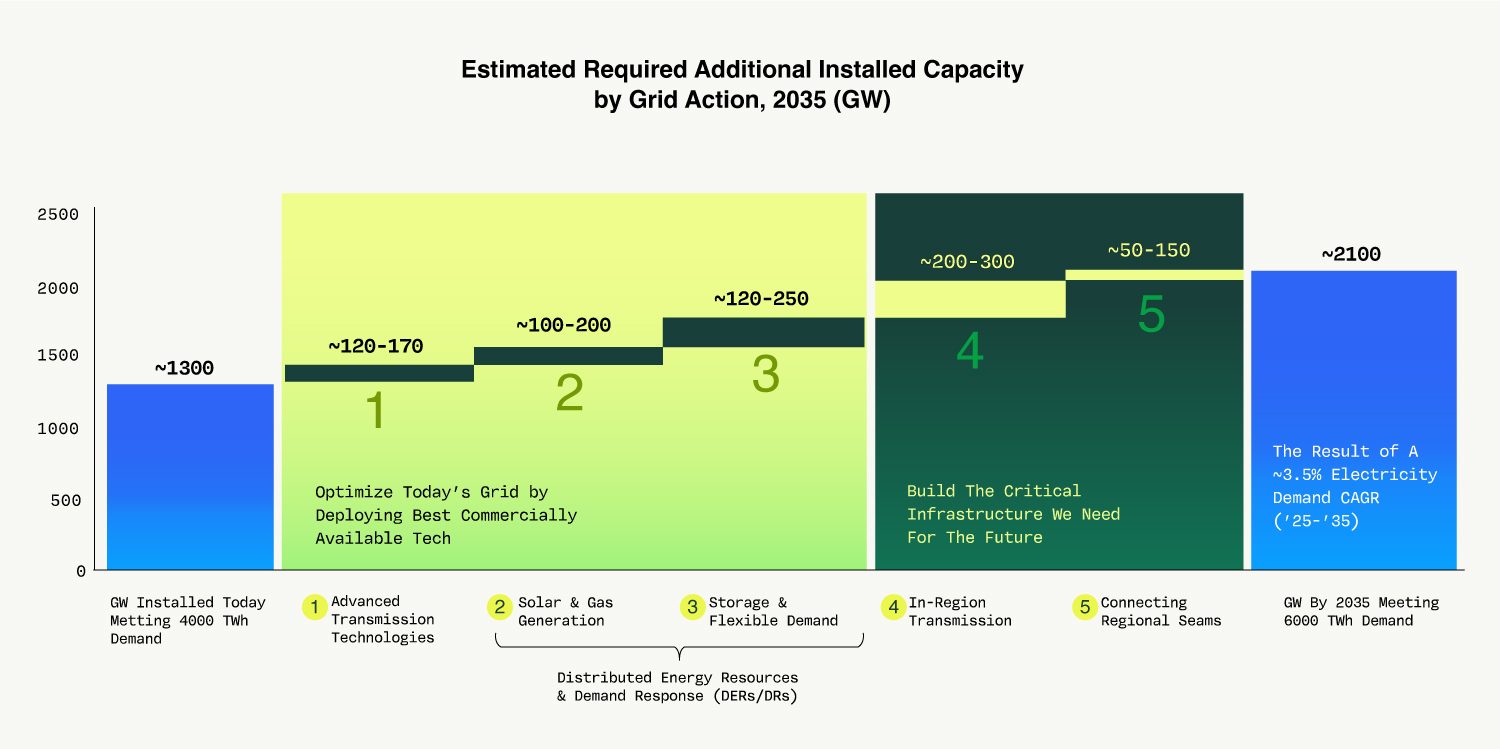

Grid Vision Solutions
A practical model enabled by policy reform, technology acceleration, and market alignment.
01
Use advanced transmission technologies (ATTs) to unlock more capacity from the existing grid, reducing congestion and increasing power flow without building new lines.
~120-170 GW capacity added by 2035
02
Scale on-site and local power generation to meet rising demand, bringing supply closer to load and accelerating speed to power.
~100-200 GW capacity added by 2035
03
Install storage and controllable load to shift demand, reduce peak strain, and improve overall system reliability.
~120-250+ GW capacity added by 2035
04
Expand local transmission to relieve bottlenecks and connect new supply.
~200-300 GW capacity added by 2035
05
Link regions together to share resources more efficiently, improve reliability, and strengthen the grid as a unified system.
~50-150 GW capacity added by 2035
Our Action Plan
Develop and communicate clear plan for optimizing today’s grid and building tomorrow’s grid.
Deliver data-driven perspectives to influence policy that expedites transmission build-out.
Showcase transformative technology and scale to key stakeholders to increase growth.
Highlight case studies and best practices to drive ATT adoption.
Identify specific, critical, and high-value transmission projects to accelerate.
Catalyze development of innovative, multi-grid transmission expansion.
Grid Vision Value



Our Grid Vision Approach
Key actions to unlock capacity, reduce congestion, and build the grid needed for growing demand by 2035.

Reconductor ~8K miles with state-of-the-art technology
Scale Virtual Power Plant (VPP) capacity ~7x
Grow Distributed Energy Resources (DERs) capacity ~2.5x
Build ~7x more transmission
Double cross-seam interconnections
Add ~3,000 HVDC transmission line miles per year
FAQ
Key questions on how the Grid Vision plan works, what it delivers, and how it drives real progress.
What are the core solutions in the Grid Vision plan?

The Grid Vision plan focuses on five coordinated solutions to expand capacity and reliability: deploying advanced transmission technologies (ATTs), developing on-site and local generation, installing storage and flexible demand, expanding in-region transmission, and connecting regional grid seams.
Together, these solutions are designed to deliver 800+ GW of additional capacity by 2035.
What types of initiatives does Grid Vision prioritize?
Initiatives are selected based on their ability to remove critical barriers and deliver near-term, scalable impact. OpenMinds assembles targeted coalitions of stakeholders with direct incentives to act, then works to advance initiatives that can move quickly from concept to execution and ultimately become self-sustaining.
What are the key enablers required to make Grid Vision successful?
Three critical enablers underpin the plan: policy reform (to address permitting and cost allocation), technology acceleration (including AI-enabled planning and grid optimization), and market alignment (using price signals and incentives to direct capital efficiently). Without these, deployment at scale is unlikely.
How does Grid Vision translate into real-world projects?
OpenMinds is advancing six targeted implementation initiatives, including federal and state policy alignment, AI-enabled planning, scaling ATTs, identifying shovel-ready transmission projects, and developing multi-grid expansion models like the “Speed to Power Loop.” These initiatives are selected for their ability to deliver near-term, measurable impact.


.svg)

.svg)


